






















Embed Spēk into your own projects: your users’ own voice speaks fluently in 22 languages.
Spēk turns any travel app into a two-way translator that speaks in the user’s own cloned voice. Record a minute, hold a button, talk, let go: the other person hears it in their language, and it sounds like your user. 22 languages, consent and biometric law handled, working on iPhone, Android and the web. We built the hard part so you don’t have to.
Spēk inside a real travel app
This is Solo’s real demo trip, running in the phone on the right, with the real Spēk inside it. Nothing is mocked: the same link integration described below, the same servers your users would hit.
- Start the demo, then scroll the trip a little and tap the Spēk pill in its action row.
- Spēk opens inside the phone, English on one side, Italian on the other, since the trip is Rome.
- Hold the button, say something, let go. Allow the microphone when your browser asks. You hear it in Italian in a stock voice; a traveler would record their own at the end.
- “Back to my trip” returns the phone to the itinerary.
Works in Chrome, Edge, Safari and Firefox, on a computer or a phone.
What your users get
Everything Spēk does on its own, inside your app. One voice recording, then every mode works in it.
Quick Talk
One phone, two people. Pick their language, hold, talk, pass the phone. Ready-made phrases and a keyboard for when talking out loud is awkward.
Table Talk
One phone in the middle of the table, up to four people, each in their own language and their own voice.
Two phones, anywhere
Your users talk with people on other phones, across the world, each in their own language.
Hands-free
Turn it on and just talk. Spēk works out who is speaking and translates both ways.
Translate a sign or menu
Point the camera at printed text and hear it read in the user’s language.
Learn the line
Tap any message and practice saying it in the other language, scored kindly.
Integrate in ten minutes: Spēk Connect
A link your app opens with the traveler’s language and the destination’s. On a phone it opens Spēk, or the installed Spēk app when there is one. Inside a framed page it opens in place and comes back when the user is done. No SDK, no keys, nothing to install. This is exactly how Solo ships it.
Build the link
Two language codes and a reference that identifies your app.
https://app.spek2me.com/quick?from=en&to=pt&ref=yourapp| Parameter | What it does |
|---|---|
from | The traveler’s language. Also sets the interface language for this visit. |
to | The other person’s language. Leave it out when you don’t know it: the other half opens a picker. |
ref | Your app’s name. Every turn is attributed to it, which is how we report usage and share revenue with you. |
Open it
On phones, open it like any link. With the Spēk app installed, iOS and Android open the app directly; otherwise the web app opens, with no sign-up before the first conversation.
<a href="https://app.spek2me.com/quick?from=en&to=ja&ref=yourapp"
   target="_blank" rel="noopener">Talk to anyone here</a>
Or embed it in place
In a framed page (a web app, a desktop view, a demo phone), add embed=1 and a return URL. Spēk lays itself out for the frame, and “Back to my trip” returns the frame to your page. The frame needs microphone permission.
<iframe src="https://app.spek2me.com/quick?from=en&to=it&ref=yourapp&embed=1&return=https%3A%2F%2Fyourapp.com%2Ftrip%2F42"
        allow="microphone; autoplay; clipboard-write"></iframe>
Return URLs are accepted only for domains registered with us, so nobody can bounce your users elsewhere. Registration is part of onboarding and takes a day.
Pick the languages from what you already know
Solo derives to from the trip’s destination city and country, and leaves it out when the destination speaks the traveler’s language. The language list, with the codes, is the same 22 the app shows.
What crosses the wire is text and the user’s own voice model, never your data. Spēk never sees your users’ bookings, itineraries or accounts.
Compliance, handled
A voice is biometric data. The rules that apply to it, BIPA in Illinois, GDPR article 9 in Europe, LGPD article 11 in Brazil, are the part most teams can’t build and can’t afford to get wrong. Spēk carries them, in every integration.
Consent before any recording
An explicit, unticked consent screen in the user’s own language, 23 languages, inside Spēk. It cannot be removed by an integration.
Adults only, own voice only
Voice cloning is 18+ and a person may only clone their own voice. Stock voices cover everyone else.
Used for their words, nothing else
A voice model speaks only that person’s own translated words. Never sold, never used to train other models.
Delete, report, block
Delete the voice or the whole account in the app. Report and block any person. Reports are acted on within 24 hours.
Paper for your lawyers
A data protection addendum with a paragraph to paste into your privacy policy, our terms and our own privacy policy.
Reviewed by the stores
The same flows passed Google Play’s review and sit in Apple’s, including user-generated-content rules and account deletion.
Solo, by Roteiro AI
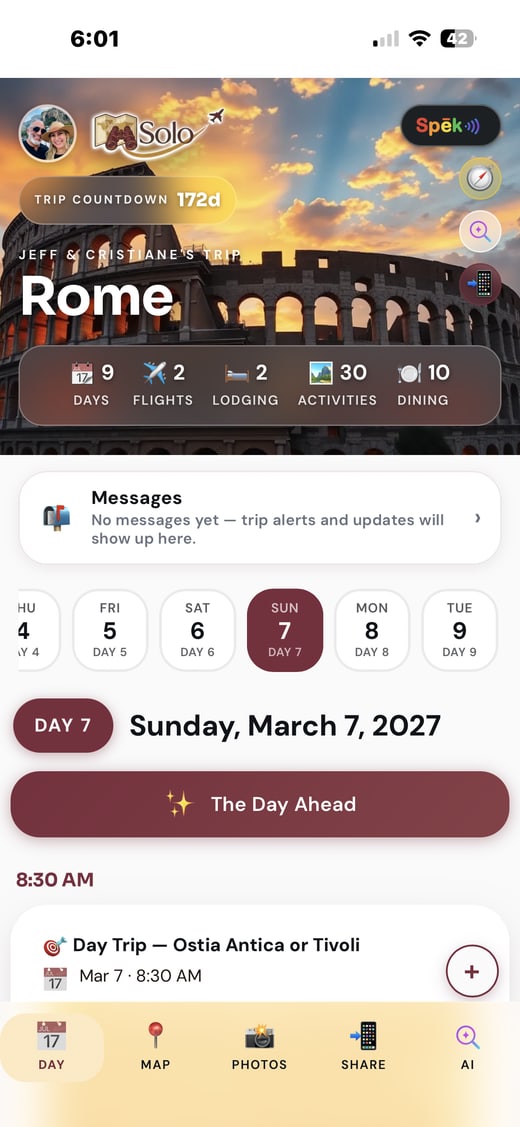
Solo is a trip app: a traveler’s itinerary as an installable web app, with the day’s plan, the places and the practical bits. Since September 2026 it ships Spēk as the “Translate” action on every trip.
- One button in the trip’s action stack, the Spēk wordmark on a dark pill. The coach tour introduces it first.
- The traveler’s language comes from the trip; the destination’s language is derived from the city and country, with Portuguese spellings handled.
- On phones the link opens Spēk, or the installed app. On the desktop trip view and in Solo’s demo phone, Spēk opens inside the frame, laid out for a 300-pixel screen, and “Back to my trip” returns.
- No account before the first conversation: the traveler starts with a stock voice and is invited to record their own after the third turn.
- Integration time: an afternoon, one file.
Roteiro AI is an ArtemisWorx company, like Spēk. It was the first integration, and it is the one every partner integration is modelled on.
What’s next
These are not available today. They are what we build next, in the order partners ask for them.
Embedded widget
Your screen, our engine: a script tag that mounts Quick Talk inside your page, themed to your app, with events out. One Spēk identity, so a traveler’s voice works in every app that has Spēk.
Capacitor and React Native packages
The same engine as a dependency, with the native pieces already written: audio routing, Bluetooth handling, notifications.
API
Voice, turn and speech endpoints with keys and metering, for teams that build their own interface.
Five partners. A year of extras.
We are early, and we would rather be honest about it than quote a user number. What early partners get instead is attention: the founder on the integration, a say in what gets built next, and our marketing pointed at you.
You get
- Spēk Connect costs you nothing, now or later. For twelve months: 20 % of the Spēk Plus revenue your users bring, after store fees
- Hands-on integration help, same-day answers
- Your logo on this page, ours on yours, a joint announcement
- First access to the widget and the packages, and a vote on their shape
- The compliance paper: our data protection addendum and a paragraph for your privacy policy
We ask
- Ship it to real travelers within 60 days
- Let us publish your results, good or bad
- A short check-in once a month, by call or email
- Leave whenever you like: remove the link and that is the end of it
Questions developers ask
How many users do you have?
Not many yet, and we would rather you judge the product than the number: the demo takes 20 seconds, the app is on Google Play, and native speakers have judged the voices in four languages. Your users are the users. A design partnership is how both of us get to the number.
What does it cost after the first year?
Spēk Connect stays free. Usage-based pricing for the widget and packages will be set with the design partners before anyone pays it. There is a per-turn cost on our side of about two cents, so the economics are not a mystery.
How fast is it?
About three seconds from the end of a sentence to hearing it in the other language, a little more on long sentences. Hands-free mode is a few seconds behind the speaker. Faster streaming is on the roadmap.
Does it work offline?
No. Translation and the user’s voice run on our servers. Saved phrases replay offline once used.
Which languages?
English, Portuguese (Brazil), Spanish, French, Italian, German, Dutch, Polish, Russian, Ukrainian, Turkish, Arabic, Hindi, Chinese, Japanese, Korean, Vietnamese, Indonesian, Filipino, Swedish, Greek and Armenian (Eastern and Western). A new language is about a day of work plus a native speaker to judge it.
Who are your vendors?
Speech and voice run on a US voice partner; translation runs on Anthropic’s Claude. We name them in contracts and data processing agreements, not in user-facing text, and we keep an alternative voice vendor evaluated.
Can we white-label it?
Spēk Connect carries the Spēk name; the embedded widget will take your theme with a “Powered by Spēk” mark. Full white-label is an enterprise conversation.