






















Feature layout of the Spēk Connect release, set as a software-magazine spread. Same facts, same quotes.
Integrations · Voice · Travel
The one-link voice translator
Spēk opens its own-voice translator to other apps, and makes the case that consent, not speech, is the hard part.
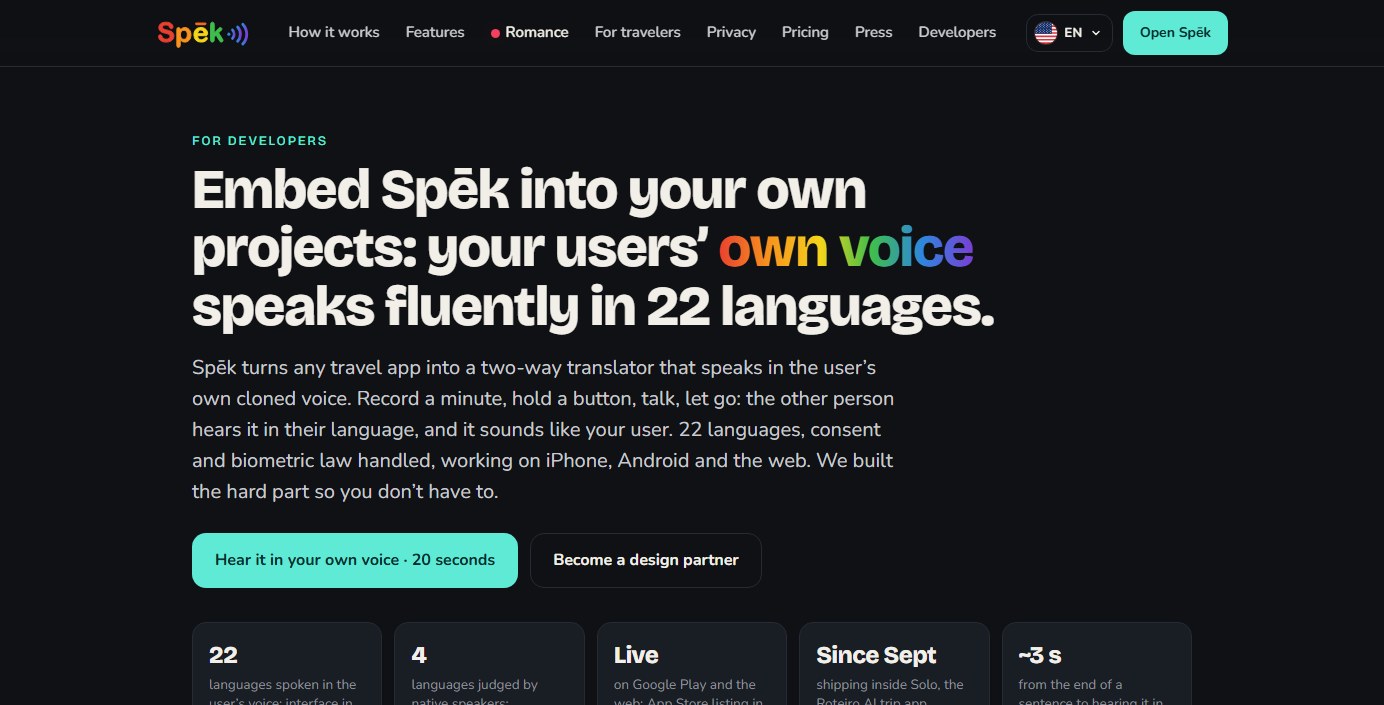
Every AI travel app launched this year has a translator in it, and every one of them sounds the same. The speech models are a commodity now: an indie developer can wire up transcription, a language model and a synthetic voice in a weekend and ship “live translation” as a bullet point. What they cannot ship in a weekend is the traveler’s own voice, cloned once and speaking Portuguese across a dinner table in Brazil. That is the thing ArtemisWorx, a small Boston-area studio, built Spēk around, and it is what the company is now offering to other developers as an integration.
It is, deliberately, not an SDK.
One link, no build step
Spēk Connect is a URL. A partner app assembles it from three things it already knows: the traveler’s language, the other person’s language, and its own name.
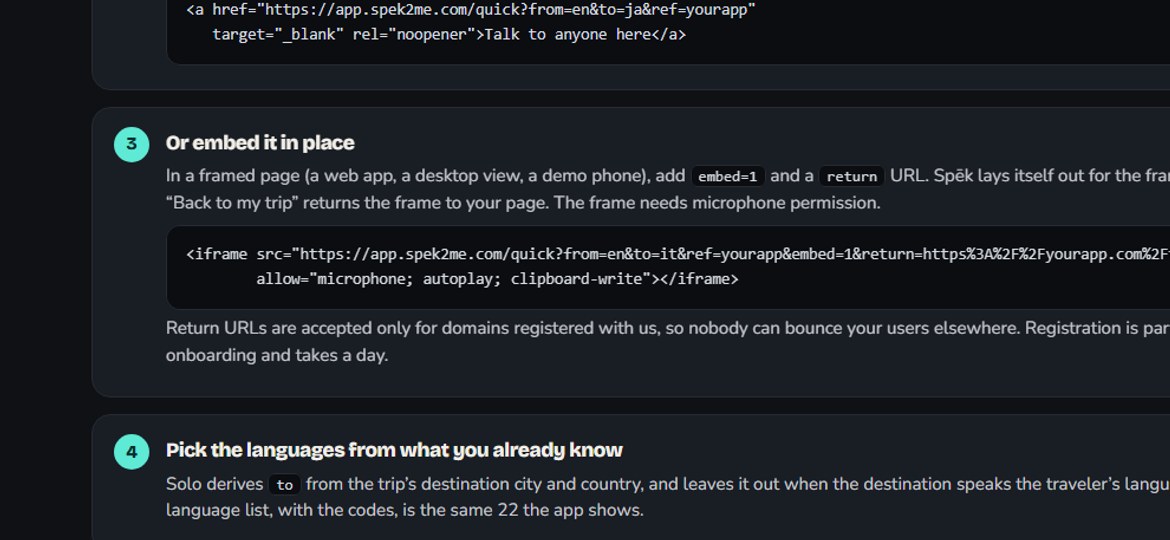
Open it and the traveler lands in a Spēk conversation with the two languages set. On a phone with the Spēk app installed, the same https link opens the app, through Universal Links on iOS and App Links on Android; on any other phone it opens the web app. The partner does not detect which. Inside a web app or a desktop view, the link runs in a frame instead, with an embed flag and a return address, and a “Back to my trip” button hands the traveler back to the page they came from.
That is the whole integration. Jeff Hagopian, ArtemisWorx’s founder, is unapologetic about how little there is to it. “We could have led with a widget and a key and a dashboard. Nobody has asked for that yet. A link is what Solo needed, it has worked since September, and it is what we can support with a team this size. The widget comes when a partner tells us they need their own screen.”
Solo is the Roteiro AI trip app, ArtemisWorx’s other product, and it has carried the Spēk link in its hero action stack since September. The integration pattern every future partner gets is the one Solo already runs.
What a developer is actually buying
Not translation. Google, Apple and Samsung all ship live translation in the operating system now, and a developer who wants a generic translator has free options. The pitch is narrower and, on inspection, harder to copy: the traveler’s own voice, working on an iPhone in Safari and inside an Android in-app browser, with the audio plumbing and the consent law already handled.
The plumbing is real. Spēk’s public engineering notes read like a catalogue of things that go wrong with microphones on phones: iOS re-prompting for the mic after a minute of silence, audio routed to the earpiece while the mic is open, Android putting the phone into call mode on every mic open and leaving it there, Bluetooth hands-free links capturing nothing once idle. Each has a fix in the product. A developer integrating by link inherits all of them without knowing they existed.
The law is the larger moat. A cloned voice is biometric data, and the statutes that cover it, Illinois’s BIPA, the GDPR’s article 9, Brazil’s LGPD, require explicit, informed, unticked consent before any recording, and real deletion afterwards. Spēk’s consent screen lives inside Spēk, in 23 languages, and an integration cannot remove it. Cloning is limited to adults and to a person’s own voice; the model speaks only that person’s translated words; delete, report and block are in the app, with reports reviewed within 24 hours. A data processing agreement and a one-page privacy-policy insert come with the integration. The same flows have already passed Google Play’s review and are sitting in Apple’s.
The honest number
The obvious question for any integration pitch is scale, and here ArtemisWorx answers it before being asked. The developer page does not quote a user count; its FAQ answers “not many yet,” and offers proof instead: a 20-second demo in which a visitor hears their own cloned voice speak a language they do not know, a live app on Google Play, and native-speaker verdicts on the voices in four languages. The design partner program is built on the same posture: five partners get Spēk Connect free for twelve months, the founder on the integration, a say in the roadmap and the company’s marketing pointed at them, and in exchange must ship to real travelers within 60 days, let their results be published, and take one call a month. It is an early-stage deal and it is labelled as one.
What is not there yet
The roadmap is explicit about what does not exist: an embedded widget, Capacitor and React Native packages, and an API. The order they ship in, the company says, is the order partners ask for them. The constraint underneath is capacity: each cloned voice occupies a slot with Spēk’s voice vendor, and a partner expecting thousands of travelers to record is told to talk to the company first. For a developer, the calculus is simple enough. The link costs nothing and takes an afternoon. What it buys is the one feature in the category that a traveler notices: when the phone speaks for them, it sounds like them.
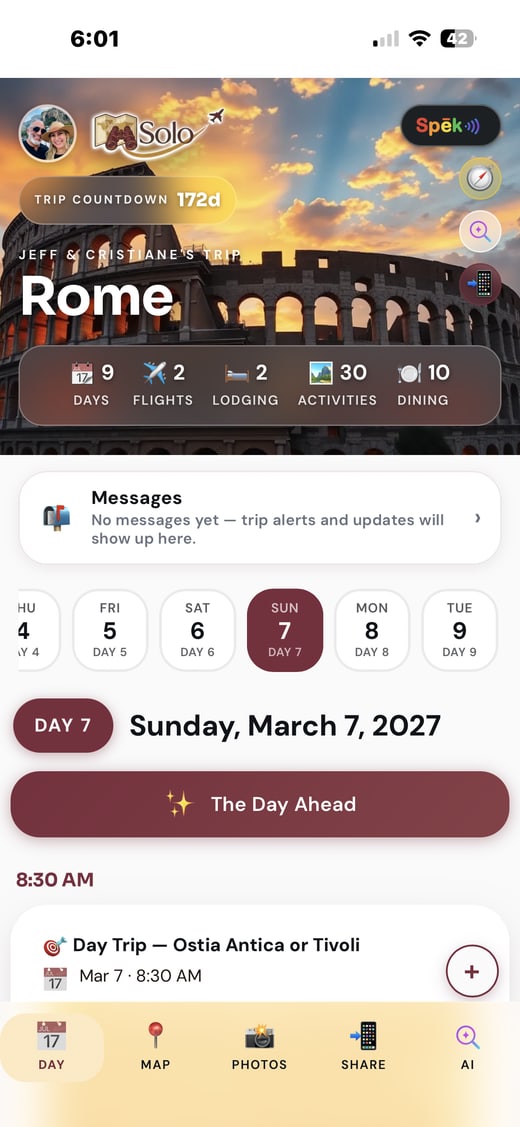

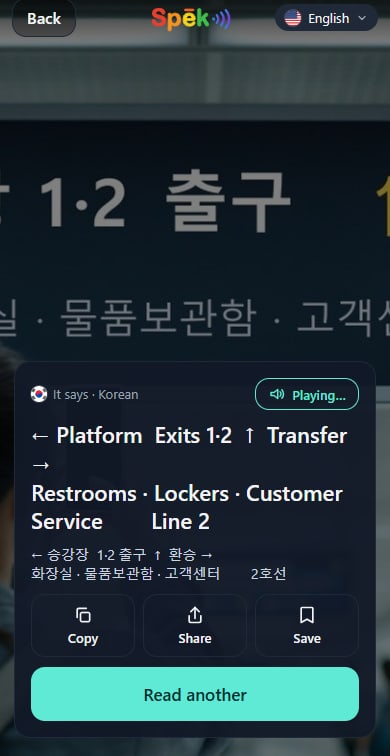
Screens The Spēk button inside Solo; the conversation a Connect link opens, both languages set; and the camera translator the traveler gets with it.
Spēk Connect at a glance
- link
- app.spek2me.com/quick?from=<lang>&to=<lang>&ref=<app>
- from, to
- ISO 639-1 codes from Spēk’s 22 languages; to is optional, Spēk asks the traveler when it is missing
- ref
- the partner’s name; every conversation is attributed to it
- installed
- opens the store app from the same https link; otherwise the web app
- framed
- embed=1 plus a return URL, in an iframe that allows microphone, autoplay and clipboard-write
- consent
- inside Spēk, 23 languages, unticked, not removable; 18+, own voice only
- cost
- free, and stays free; pricing for the widget, packages and API set with partners
- status
- Google Play live, web live, App Store in review
- Build the link from the two languages and your app’s name.
- Open it in a tab, or embed it in a frame with a return URL.
- The traveler talks. Spēk handles consent, the voice and the microphone.
- Back to my trip returns them to your page.